Opinion | For Years, Azerbaijan Backed Pak, Snubbed India. Now Comes The U-Turn
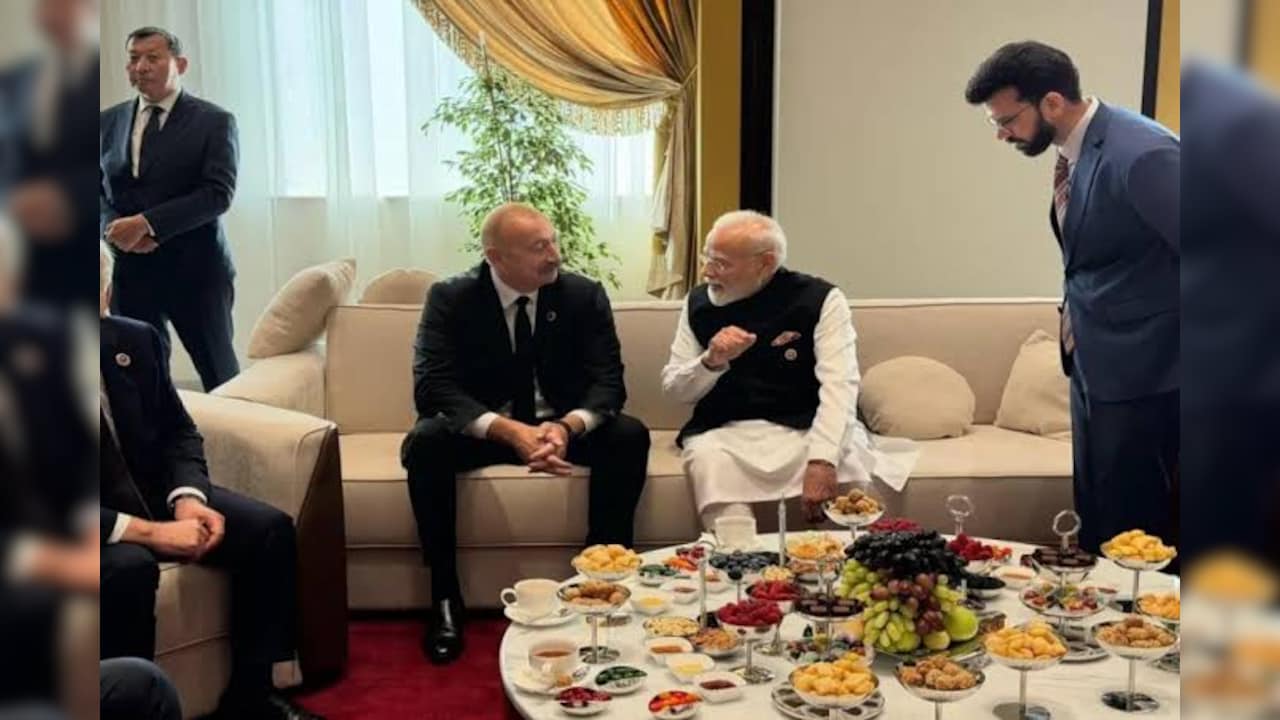
On the sidelines of the recent summit of the heads of states of the members of the Shanghai Cooperation Organization (SCO) held in Bishkek, Kyrgyzstan, Prime Minister Narendra Modi held a series of bilateral meetings. While most of them, with those like the meetings with Russian President Vladimir Putin and Armenian Prime Minister Nikol Pashinyan, were covered by the Indian media, one went overlooked - that with Azerbaijan's President Ilham Aliyev. Just consider, almost a year ago at a similar SCO summit meeting in Tianjin, China, Baku had alleged that India, together with some other member states, had blocked its bid for entry to the organisation. A year later, Modi and Aliyev were holding a bilateral meeting at an event where Pakistani Prime Minister Shehbaz Sharif and Turkish President Recep Tayyip Erdogan were also present.
For Baku, this was certainly a consequential moment - it was splashed all across the country's media, which had been overtly hostile to India just a while ago. Bilateral ties, always strained, nosedived after Operation Sindoor, where Baku had come out strongly in support of Islamabad and condemned India's actions. So, what prompted this course-correction now?
The First Breakthrough
A breakthrough was first witnessed earlier this year, when India and Azerbaijan held the 6th round of Foreign Office Consultations in Baku, the first such talks since 2022. The talks were held between India's Ministry of External Affairs Secretary (West), Sibi George, and Azerbaijan's Deputy Foreign Minister, Elnur Mammadov, on Friday. In a statement, the MEA release for the meeting said, "[The two sides] comprehensively reviewed the current state of bilateral relations covering areas of mutual interest. The issues discussed included trade, technology, tourism, pharmaceuticals, energy, culture, people-to-people exchanges, and a fight against cross-border terrorism." Secretary (West) also met Hikmet Hajiyev, the Foreign Policy Advisor to the President of Azerbaijan.
The term "cross-border terrorism" is significant. While for Baku, it could allude to either rival Armenia or Iran, with whom it shares a complicated relationship, for India, it is clearly Pakistan, for it is the only country that has been fomenting cross-border terror for India. Last year, when India initiated Operation Sindoor precisely in response to such cross-border transgressions, Baku had come out strongly in support of Pakistan.
This reset in ties, though obvious, is perhaps not surprising. Both countries have much to gain from cordial relations with each other. However, Azerbaijan stands to gain more. And while India has always struck a conciliatory position, it is Baku that has usually taken a strident position vis a vis Delhi.
A Calculated Change Of Heart
Consider the facts. Azerbaijan, as part of the erstwhile Soviet Union, had cordial relations with India, which recognised it as a sovereign state in 1992 as it emerged as an independent nation following the collapse of the Soviet Union. Yet, while India's relations with all other former Soviet states took off on an even keel, with Azerbaijan, they remained dormant. The Indian diplomatic mission in Baku was opened only in March 1999, while Azerbaijan opened its diplomatic mission in Delhi even later, in 2004. It took even longer to appoint an Ambassador. Twenty-years later, there have been no major high-profile official bilateral visits between the two sides at the level of heads of state or government.
Meanwhile, over the years, India's bilateral trade with Azerbaijan has increased substantially. According to government data, bilateral trade jumped from around USD 50 million in 2005 to USD 1.435 billion in 2023, with India becoming Azerbaijan's seventh-largest trading partner. But trade remains firmly tilted in Azerbaijan's favour, primarily on account of its crude exports to India. So, while India's imports from Azerbaijan were USD 1.23 billion, exports were only about USD 201 million. The same year, tourist footfall from India was around 1.17 lakh tourists.
Yet, Azerbaijan, while deepening ties with Pakistan, including in defence, took umbrage at India for its defence exports to Armenia, though there is still no record of the latter deploying Indian weapons during its wars with Azerbaijan. It didn't stop there. While India took a neutral position over Nagorno-Karabakh, the contested territory between Armenia and Azerbaijan, which the latter finally managed to wrest militarily from Armenia, Azerbaijan echoed Pakistan's position on Jammu and Kashmir. That's not all; it allowed Kashmir Day events by the Pakistan Embassy on its territory, condemned India's reorganisation of Jammu and Kashmir, and, earlier this year, even allowed a conference organised by Khalistani supporters.
Perhaps it has now realised that pursuing good relations with India will reap richer dividends for it. The plunge in the number of Indian tourists - a mainstay of the country's economy - by almost 30% following Operation Sindoor was certainly not encouraging for it. Following energy export disruptions in the Middle East, the Indian energy market would also assume greater salience for Baku. In 2023, India was the third-largest destination for Azerbaijan's crude oil. Moreover, ONGC Videsh Ltd holds active stakes in Azerbaijani oil and pipeline assets, including the Azeri-Chirag-Gunashli oil field and the Baku-Tbilisi-Ceyhan pipeline.
The Two Peace Processes
The ongoing peace process with Armenia is another factor in the bilateral decision to reset ties. Baku has been seriously alarmed by India's export of sophisticated weapons systems to Armenia, especially the Pinaka Multi-Barrel Rocket Launchers and the Akash Air Defence Systems, as well as suggestions about the supply of the BrahMos cruise missiles. Baku has alternatively slandered Indian arms, threatened India, and even offered to purchase Indian military hardware via a third country. Resetting ties with India would, therefore, certainly preempt any military threat from it.
Normalisation, however, has a price - strain in Azerbaijan's ties with Turkey. The once self-acclaimed "One Nation, Two States" dynamic may not last long. As Azerbaijan and Armenia negotiate a peace deal, Armenia is also simultaneously in the process of normalising its ties with Turkey after a hiatus of almost a century. Of late, this has assumed the form of direct border crossing and passage of cargo and freight. Azerbaijan, however, wanted such normalisation to be contingent on the finalisation of its peace agreement with Armenia. While Turkey has for now deferred the establishment of full-fledged diplomatic ties with Armenia, it sees no reason to postpone the normalisation process.
Another emerging fault line in bilateral relations may be Turkey's inclusion in the Mecca Pact and escalating tensions with Israel, one of Azerbaijan's closest energy and defence partners. The overt religiosity of the Mecca Pact, as well as Turkey's current Islamo-sensitivity, is bound to cause discomfort in Azerbaijan, which is a strongly secular state, as most former Soviet states are. On the other hand, escalating Israeli-Turkish tensions have already become an irritant in Turkey's relations with Azerbaijan. Last year, in May, The Times of Israel reported that Prime Minister Benjamin Netanyahu canceled his planned visit to Baku because Turkey refused to grant his state plane overflight rights.
India's Opportunity
India will certainly seek to exploit this and perhaps wean Baku away from Turkey's embrace as the latter increasingly becomes a strategic threat for India. Besides, the country also offers India a good market for its exports and is also useful for India's connectivity ambitions in Eurasia, being part of the International North South Transport Corridor (INSTC).
The Modi-Alyev meeting in Bishkek, therefore, certainly points to a new dawn in bilateral ties, a mutual recognition that relations can be rethought and not continue to be viewed through the India-Pakistan or Armenia-Azerbaijan prisms.
However, considering that it was Baku that held back initially from cultivating good ties with India, and has taken a number of provocative actions against India, Delhi should be careful and watchful, even as it continues its engagement.
(The author is a senior journalist)
Disclaimer: These are the personal opinions of the author